Other platforms see a clearcut and call it deforestation. We see managed forestry — and prove it.
LandTrace is satellite-verified EUDR compliance for the US forest products sector — lumber, veneer, plywood, panels, pellets and more. Where generic tools run a single tree-cover-loss check and flag every harvest, LandTrace matches each opening to the public harvest record behind it, checks it against the satellite evidence, and clears it by a documented rule.
Same signal as illegal clearing. Shipment held at customs.
State harvest record matched · no farm conversion · regrowth on track.
One tree-cover check fails on US timber.
Many EUDR platforms run a single tree-cover-loss check. On American working forests, that means a routine harvest can read exactly like illegal deforestation in the Amazon — even though the land stays forest and regrows.
A 40-acre clearcut in a managed forest returns the identical signal to permanent agricultural conversion. No distinction between a harvest that will regrow and forest that's gone for good.
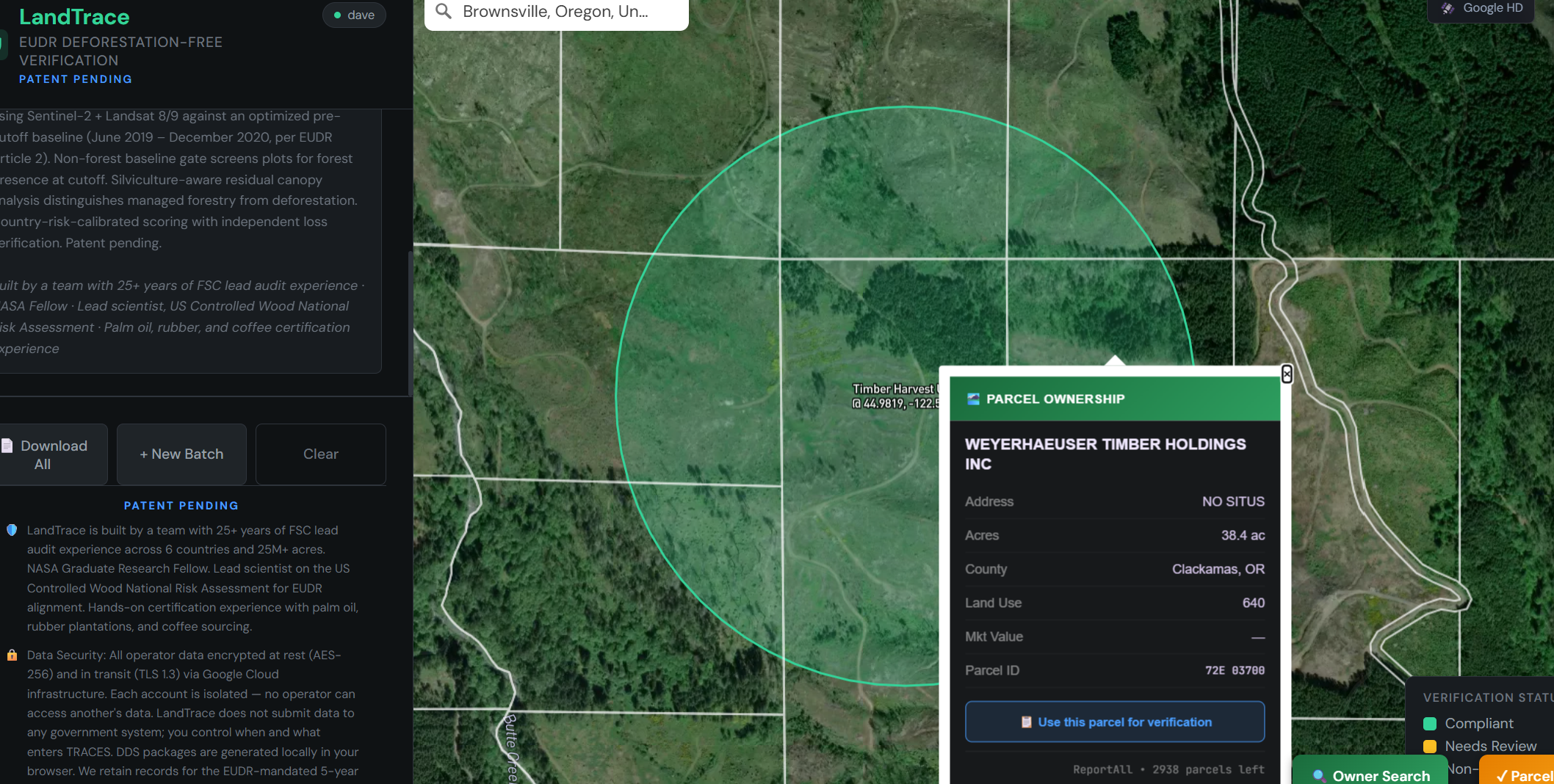
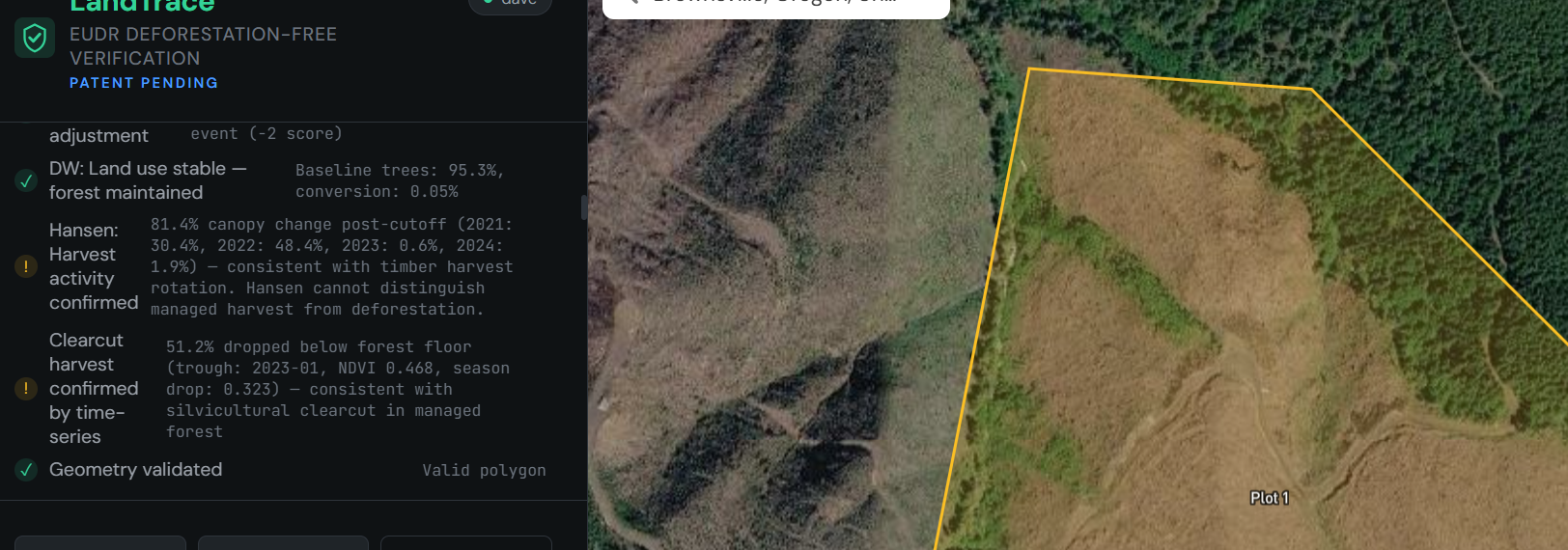
The same cut, checked the way an auditor would: it matches a state harvest notification, Dynamic World and the USDA Cropland Data Layer show no farm use, the time series dates the cut, and the stand record shows second growth — not primary forest.
Record first, satellite as evidence, a rule for every clear.
Every plot is tested against the same published conditions, in order. A plot clears when every condition holds, and every outcome is logged with the rule that decided it.
Harvest records
State, federal and other public harvest records. The operator's unit boundary and record number travel with every plot.
Openings sweep
Optical change plus radar across the whole wood basket finds every cut in the window, including the ones nobody filed. Sentinel-2 · Sentinel-1
Forest at the cutoff
Forest on Dec 31, 2020 per JRC GFC 2020, Hansen and a 2019–2020 baseline. Ground harvested just before the cutoff still counts as forest (Art. 2(4)).
No farm conversion
Dynamic World and the USDA Cropland Data Layer catch crops, orchards, hay and Christmas trees after the cut; pasture is caught by the regrowth test.
Not primary, not protected
GFT 2020 plus the stand's own record — disturbance history, canopy height, stand age — and PAD-US GAP 1 wilderness and research natural areas.
Fire & regrowth
Interagency fire perimeters separate wildfire from harvest; salvage is accepted with a record. Years two and three re-check that the ground is regrowing.
Two paths. Where public harvest records exist, the record says what happened and the satellite confirms it. Elsewhere, the satellite harvest signature decides, legality rests on mill or landowner documents, and the sample rate doubles. Beyond US timber, plots run our six-check Sentinel-2 convergence analysis, calibrated to the country's risk tier.
Built for the US forest products sector — at any scale.
If your wood products reach the EU market, EUDR reaches back to the harvest. LandTrace fits the way American wood actually moves — landowner and logger to mill, mill to plant, plant to exporter — and each link can hand the next a ready evidence package.
Sawmills & lumber exporters
Dimensional softwood and hardwood lumber, siding, and trim shipped to EU buyers.
Veneer & plywood
Face veneer, plywood, and engineered wood where origin traces to specific harvest units.
Pellets & panels
Wood pellets, particleboard and OSB (HS 4401, 4410–4411) built from residue and roundwood across many supplying mills.
Secondary manufacturers
Furniture, flooring, and components needing a defensible DDS from their wood supply.
FSC, PEFC & SFI certified operations
Certification alone isn't EUDR compliance. LandTrace adds the plot geolocation and deforestation-free evidence your EU buyer needs, and covers due diligence on your uncertified supply.
Mills running residues
Chips, sawdust, and by-products are a many-to-many traceability problem with its own approach.
See the residuals method →From a harvest unit to a customs-ready file.
Satellite verification report
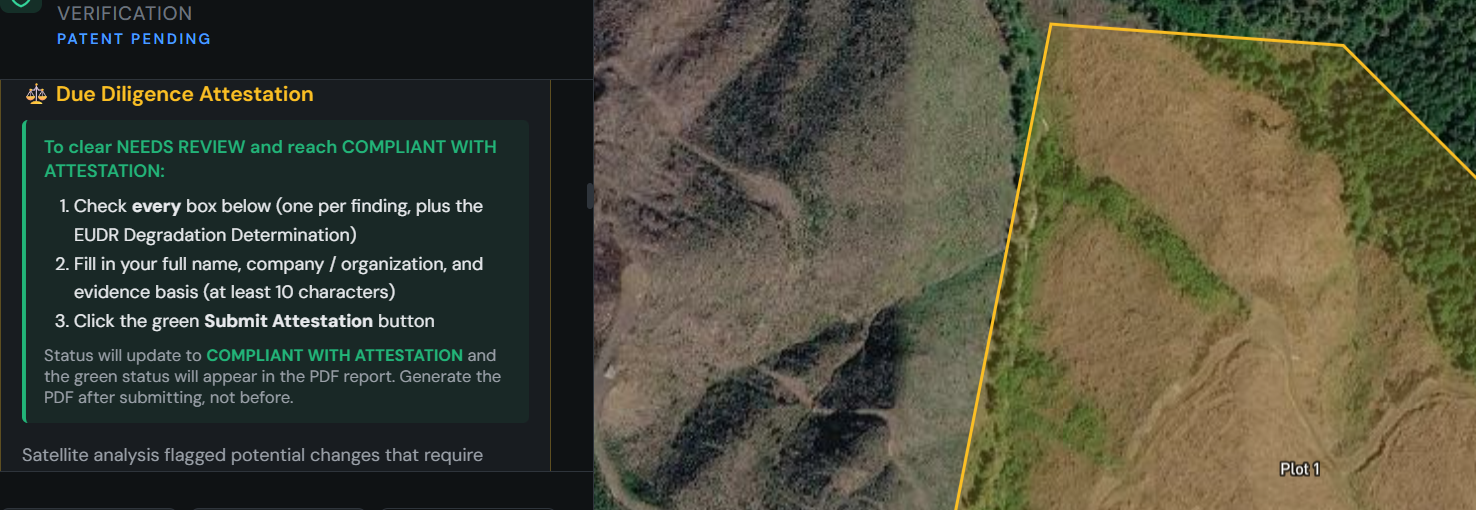
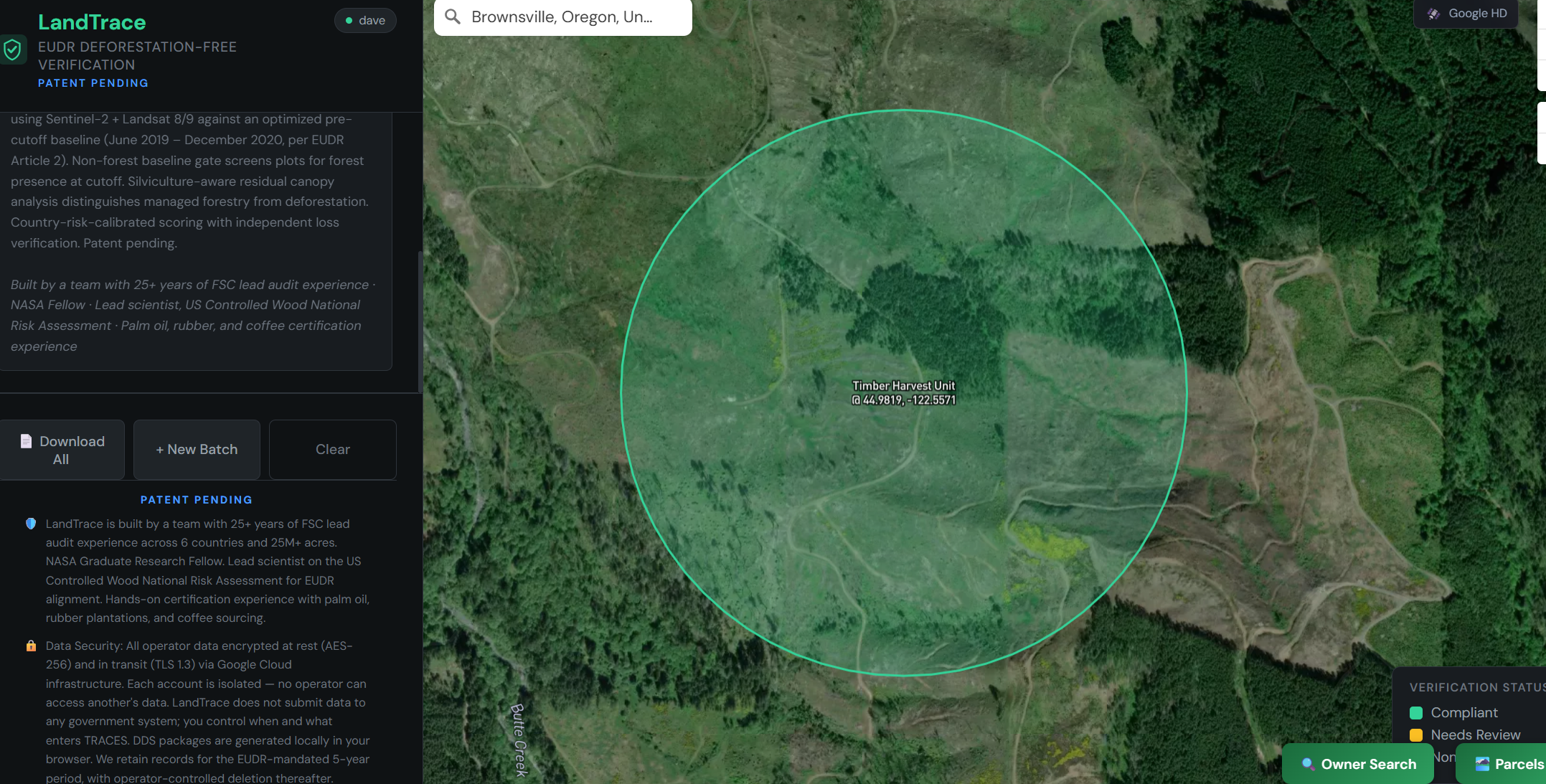
Cleared, review or not cleared — with the rule that decided it, the parcel on a satellite map and a full evidence PDF tracing every finding to its source.
Guided DDS package
A 7-step wizard — operator, product, origin & geolocation, supply chain, legality, structured Article 10 risk assessment, review & generate.
TRACES-ready output
Complete DDS PDF with all Article 9 / Annex II fields plus a separate GeoJSON for geolocation upload — generated client-side, nothing submitted without you.
Yearly monitoring
Every declared plot is re-checked each growing season for three years after harvest — farm conversion, pasture or failed regrowth flagged early — with 5-year record retention.
The map, the verdict, the evidence.
Draw or upload a parcel, run the verification on a satellite basemap, and walk away with a TRACES-ready file your EU buyer can rely on.
An EUDR forest platform that, unlike most, publishes its method.
Most EUDR tools are data-collection suites that license third-party remote sensing or run a single undisclosed check. LandTrace is built by a forester, with verification in-house.
Records plus evidence, not a single layer
A harvest record on file, satellite signals that agree, and a documented rule for every clear — not one outsourced score.
Silviculture-aware
A dedicated managed-harvest gate, so routine forestry clears instead of failing — far fewer false positives to chase.
Fire & salvage handling
Interagency fire perimeters separate wildfire from harvest and conversion — salvage from burned land is accepted with a record, not treated as deforestation.
Transparent & defensible
Public methodology and a full audit trail, built to be attested by a qualified forester and to withstand a substantiated-concern challenge.
Built by auditors, not a tech startup
Data security
- Operator data encrypted at rest (AES-256) and in transit (TLS 1.3) on Google Cloud
- Every account is isolated — no operator can access another's data
- DDS generated locally in your browser — nothing submitted to any government system without you
- Records retained for the EUDR-mandated 5 years, with operator-controlled deletion
Prefer it handled? Your whole wood basket, end to end.
Our team runs a published, versioned verification procedure across every supplying mill's basket and hands you an audit-ready due diligence package — billed hourly, no software fee.
Build the plot set
Every harvest record in the basket crossed with a satellite openings sweep: cut units enter the set, notified-but-uncut units drop out, and unrecorded openings are flagged.
Clear by rule
Each plot runs rules R1–R8 on documentary and satellite evidence. Plots that pass clear by rule; anything else goes to review. Every clear is logged with its rule.
Forester review and sample
A qualified forester decides every exception on documents and re-checks a stratified random sample of rule-cleared plots, blind to the rule outcome.
Mill confirmation and deliverable
Each mill answers a short list — ours, or not our wood. You get the EU Information System GeoJSON, the evidence package, the attestation wording and yearly monitoring.
Simple, honest pricing.
Start free, scale on a flat monthly rate, or have our team run the whole assessment for you — no per-parcel metering, no enterprise sales call.
Run three full verifications on your own harvest units — no account, no commitment. See exactly how LandTrace classifies your forest.
- Full rules-based verification
- Satellite map with parcel boundary
- Evidence PDF for each verification
Everything, unlimited verifications, one price. Cancel anytime.
- Unlimited verifications across all your parcels
- 7-step DDS wizard + TRACES-ready output (PDF + GeoJSON)
- Supply-shed screening & permit reconciliation
- Yearly re-check for three years after harvest
- Evidence PDFs with full audit trail
- 5-year record retention
Prefer it handled? Our team runs the full procedure — records plus satellite plot set, rule clearing, forester review, mill short lists — and hands you an audit-ready package.
- Expert-led risk assessment & verification
- Records + satellite plot set, forester review & sample
- Billed hourly, sized to your basket's size & complexity
- No software, platform, or subscription fee
Software is a flat $175/month, unlimited verifications. Done-for-you assessments are billed hourly — no software fee.
Common questions.
Does EUDR apply to a US mill, logger or pellet plant?
The legal duty sits with the company that first places the product on the EU market — usually the EU importer. US suppliers aren't regulated directly, but the importer can't file without plot geolocation and deforestation-free evidence from its supply chain, so in practice the request lands on the US mill or plant. LandTrace produces that evidence in the form the importer needs.
When does it start?
December 30, 2026 for large and medium operators, and June 30, 2027 for micro and small operators. Wood shipped after those dates needs the evidence in place before it ships, so the work on a winter shipment starts in the fall.
Is a clearcut deforestation under EUDR?
No. EUDR defines deforestation as converting forest to agricultural use. A harvest followed by regrowth stays forest. The risk is conversion — a cut that turns into pasture, crops, an orchard or a Christmas tree farm — and that is what LandTrace tests for, at the time of harvest and again for three years after.
What about salvage after a wildfire?
Burned forest is still forest. Salvage from inside an interagency fire perimeter is accepted when it's covered by a harvest record or a mill document, and burned ground is given time to regrow before it's judged.
Our wood comes in as chips and sawdust. Can we still comply?
Yes. Residue can't be traced to one plot, so you declare every harvest unit that could have supplied it: cut inside your supplying mills' wood baskets during the delivery window, each cleared by rule. Mills confirm a short list of the few items that couldn't be cleared. See the residuals method.
We're FSC, PEFC or SFI certified. Isn't that enough?
Not on its own. Certification doesn't supply the plot geolocation or the deforestation-free evidence EUDR asks for, and it doesn't cover your uncertified supply. LandTrace adds both, and fits alongside your existing due diligence on uncertified wood.
What's the difference between the app and done-for-you?
The app verifies plots you draw or upload and gives you the result, the rule behind it and the evidence file. Done-for-you is our team running the full procedure across your whole wood basket — building the plot set, forester review of every exception, a random sample of cleared plots, mill short lists and a signed attestation.
What does the EU importer actually receive?
The plot list as a GeoJSON file ready for the EU Information System, an evidence package with the outcome and deciding rule for every plot, and wording for the basis of their due diligence statement. The importer files the statement; LandTrace doesn't file on their behalf.
What happens if a problem shows up after the wood has shipped?
Every declared plot is re-checked each growing season for three years. A finding is reported to the exporter within five working days with the evidence, so the importer can meet its duty to act on new information. That landowner's ground is excluded from future shipments; the original declaration, made on the information available at the time, stands.
Who sees our data?
Only your account. Data is encrypted at rest and in transit on Google Cloud, accounts are isolated, the DDS file is generated in your browser, and records are kept for the five years EUDR requires, with deletion under your control.
Get EUDR-ready before December 30, 2026.
Large and medium operators apply from December 30, 2026; micro and small from June 30, 2027. Run a harvest unit you know well and watch the full verification — or start with three free verifications, no account required.
Talk to us.
Tell us what you're sourcing and we'll get back to you. Or email dave@treeringpens.com directly.